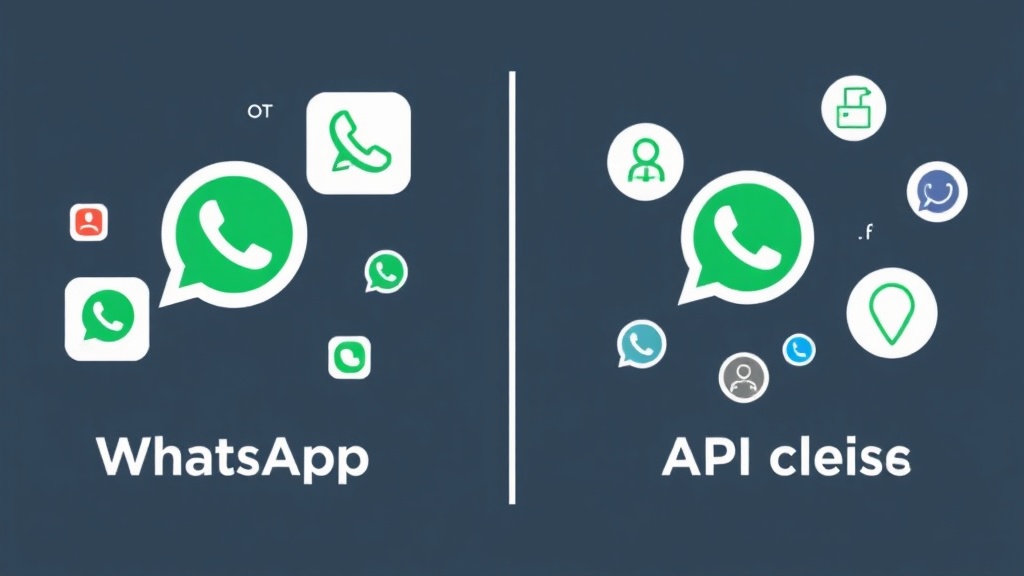
If you're running a business on WhatsApp, you've probably heard the terms "WhatsApp Business app" and "WhatsApp Business API" thrown around interchangeably. They're not. I've helped teams make this decision before, and the confusion costs real time and money. This guide breaks down the actual whatsapp business api differences features so you pick the right one for where your business is now—not where you hope it'll be someday.
WhatsApp Business App vs API: They're Not the Same Thing
Let's kill the confusion immediately. The WhatsApp Business app is the free mobile application you download from the App Store or Google Play. It's designed for small business owners and solopreneurs who want to look more professional on WhatsApp. You get a business profile, quick replies, message templates, and some basic automation.
The WhatsApp Business API is enterprise infrastructure. You don't download it. You integrate it into your business system through Meta's developer platform. It's what large companies, e-commerce platforms, and support teams use when they're handling hundreds of customer conversations daily.
The key difference: the app is consumer-facing tooling; the API is backend infrastructure. Many small business owners don't realize they even have a choice, so they spin wheels trying to scale the app beyond what it was built to handle.
Scale Is Where WhatsApp Business API Differences Show Up
The Business app can handle maybe 50 concurrent conversations before it becomes painful to manage. The API? Thousands. And the way they handle volume is completely different.
With the app, every message you send uses your phone as a relay. If your phone loses internet for 30 seconds, your message gets queued. If you're handling Black Friday inquiries and 200 customers hit you at once, you're genuinely bottlenecked by a single device. The API, on the other hand, runs on Meta's servers. Your message queuing is reliable. Delivery tracking is instant. Response times are measured in milliseconds, not seconds.
Here's what actually matters: if you're sending 5-10 messages a day and getting maybe 3 replies, the Business app works fine. If you're getting 100+ daily conversations, the API is the only reasonable choice. It's not about features at that point—it's about the system's ability to handle the load without you becoming the bottleneck.
Features That Only the WhatsApp Business API Gives You
The Business app lets you pre-write quick replies and set up away messages. Useful, sure. But it stops there.
The API unlocks template messages—pre-approved message formats that you can send at scale without hitting rate limits. Think transactional notifications: order confirmations, shipping updates, password resets. You write the template once, Meta approves it, and then you can send it to thousands of customers without WhatsApp's system thinking you're spam.
Then there's webhook integration. Your API can listen for incoming messages and automatically pass them to your CRM, your support ticketing system, or your e-commerce backend. A customer asks about an order, and instantly—without manual intervention—your system pulls their order history and queues a response. The app has no integration layer. Everything is manual.
Delivery and read receipts work differently too. The API gives you precise timestamps and status updates you can track programmatically. The app shows you a checkmark or two checkmarks, and that's it. If you're running a customer support operation, that difference between "message sent" and "message read" actually matters for SLA tracking.
Why Setup and Integration Matter More Than You Think
The Business app needs zero setup. Download it. Create a profile. Done.
The API requires developer involvement. You need someone who understands REST APIs and webhooks. You submit an application to Meta. They ask questions about how you'll use it. You wait for approval—anywhere from a few days to a few weeks depending on your use case. Then your developer integrates it into your systems. Then you test. Then you go live.
Honestly, this is a barrier for most non-technical founders. And Meta knows it, which is why they guard API access more carefully than app access. They want to make sure you're not going to use it to spam people.
The flip side: if you're already planning to scale, waiting for API approval upfront is way smarter than hitting the Business app ceiling six months in and scrambling to rebuild everything on the API.
Making the Right Pick for Your Business
Use the Business app if you're solo or a tiny team with fewer than 20 daily customer conversations. Use the API if you're handling 100+ daily conversations or you need automation that ties into your existing systems.
The middle ground (20-100 conversations) is awkward. You can limp along with the app, but you'll feel the friction. If you're sitting there, decide: are you going to stay small, or are you scaling? That answer determines whether you spend time on the API now or optimize the app for another year.

WASendly WhatsApp Bulk Message Sender
If you're managing a growing contact list and templated messages feel tedious to send one-by-one, WASendly lets you send personalized WhatsApp messages to hundreds of contacts in seconds—no API setup, no developer needed, just one click.
Try It Free →Frequently Asked Questions
Can I upgrade from WhatsApp Business app to the API later without losing contacts?
Yes, but it's not automatic. Your contacts stay in your WhatsApp account either way. When you switch to the API, you'll still have access to your message history and contact list. The integration process doesn't touch your existing data. That said, migrating your workflows—like templates, automation rules, and integrations—requires manual setup. It's doable, just not a flip-of-a-switch operation.
Do I need technical skills to use the WhatsApp Business API?
You don't need to be a developer yourself, but you'll need one on your team. The API requires someone who understands REST APIs, can read Meta's documentation, and can integrate webhooks into your backend. Some tools abstract away the complexity, but core integration still needs technical hands. The Business app, by contrast, is designed for non-technical users.
Is the WhatsApp Business app suitable for e-commerce customer support?
For small e-commerce (under 50 orders per day), yes—it works fine. You can send order confirmations, answer common questions, and handle returns manually. But if you're doing volume, you'll hit the app's limits fast. No order-lookup automation, no CRM integration, and no ability to send at scale without manual work. Most growing e-commerce teams move to the API within 6-12 months.
How long does it take to get approved for WhatsApp Business API access?
Meta typically approves applications within 3-7 business days, though some cases take longer depending on your use case and completeness of your application. High-risk categories (like lending or financial services) may require more scrutiny. Plan for two weeks to be safe, and start the application process before you actually need it live.
Conclusion
The app is simple and free. The API is powerful and scalable. They solve different problems, and picking the wrong one wastes time you can't get back.
Here's what you need to do: spend 30 minutes this week auditing how many customer conversations you're handling per day. Count actual back-and-forth exchanges, not broadcast messages. That number tells you whether you're app territory or API territory. If you're sitting at the edge, apply for API approval now anyway—you can use the app while you wait, and you'll have the infrastructure ready when you need it.