Used car valuation
for Sahibinden listings
Open a car listing on sahibinden and a panel shows what that car is really worth: the market average for cars with the same trim and version, how damage and repaint move the price, and the issues that engine family is known for. No copy-paste, no leaving the page.
- Same trim, same version
- Damage priced item by item
- Reads only the listing you opened

Before you install: this extension is built for Turkey
It works on sahibinden, Turkey's classifieds site, and the panel's interface is in Turkish. The valuation is based on the Turkish used-car market. If you are shopping for a car outside Turkey, this extension will not help you — we would rather tell you now than have you install it and find out.
Install it, then just open a listing
No settings, no sign-up form, nothing to copy.
Install the extension
Works on Chrome, Edge, Brave, Opera and Vivaldi. Nothing to configure afterwards.
Open a car listing
A yellow button appears in the bottom-right corner of any sahibinden car listing.
Read the panel
Price, condition, engine and a seller checklist — four tabs, without leaving the listing.
Four tabs, four different questions
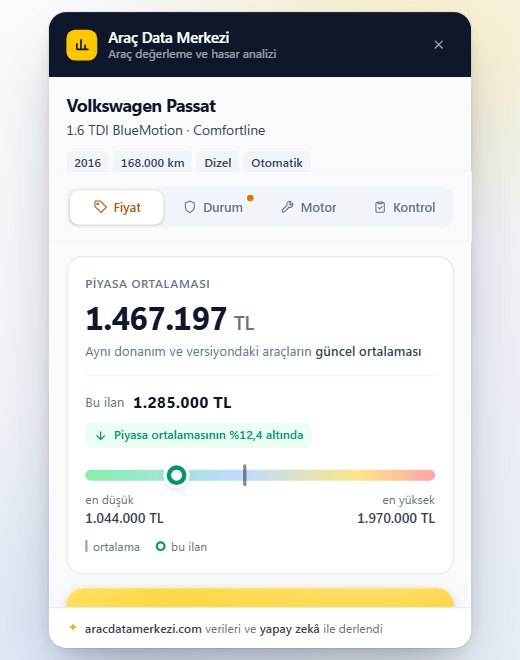
Market average and adjusted value
The panel first gives the current average for cars with the same trim and version, then adjusts that average for this car's mileage and damage — and tells you which item moved the price, as a percentage.
- Where this listing sits in the price range
- Each factor's effect shown as a percentage
- If the data is thin, no number is shown
Damage, repaint and what it costs you
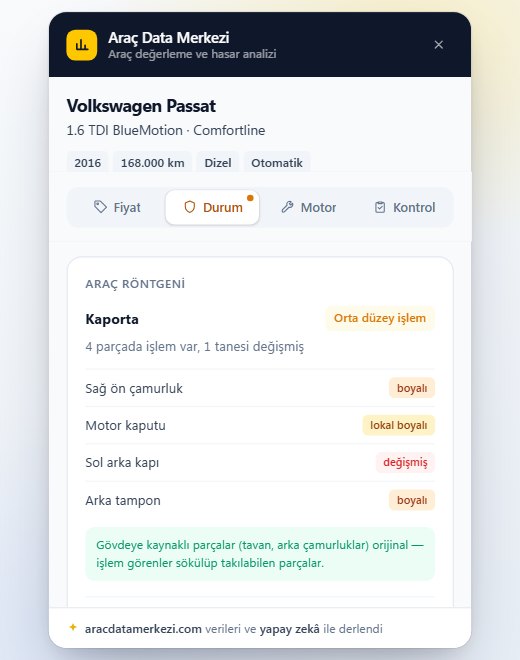
The extension reads the inspection diagram inside the listing and counts repainted, locally repainted and replaced panels — then prices each one separately, so your negotiating room is a number rather than a feeling.
- Repainted · locally repainted · replaced
- Mileage compared with cars of the same age
- The seller's own damage declaration, surfaced
What that engine is known for
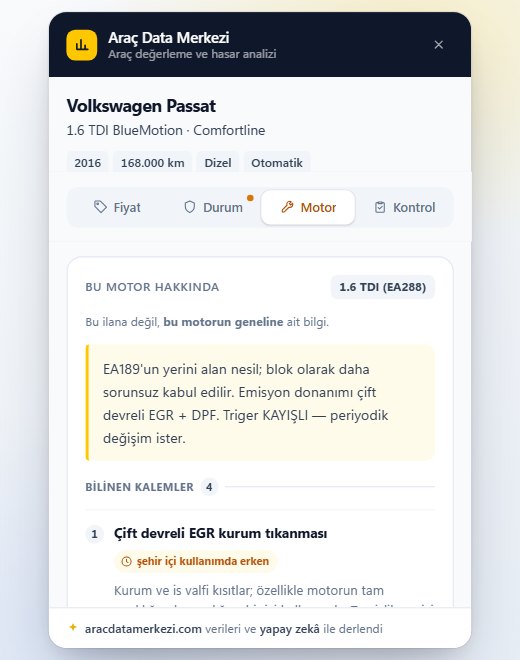
Price is not everything. Two cars at the same price can cost very different amounts to own, because of the engine family. The panel lists the issues reported in the field for that engine, roughly when they appear, and what you would notice when you look at the car.
- How many items, and when they show up
- Battery age on hybrids, tank age on LPG cars
- Each card's sources are shown in the panel
What this extension does not do
If you came looking for one of these, it will not help.
- No official accident-history report
- No VIN or plate lookup
- No inspection report of its own
- No lien, seizure or roadworthiness records
- No diagnosis of the specific car
- Works only on sahibinden, nowhere else
The damage figure shown in the panel is what the seller wrote in their own listing description — it is not an official record, and the panel says so. For official records, use the relevant authority's own channels.
What to settle before you drive out to see a car
Most of the value of a viewing is decided before it starts — by what you already know and what you remembered to ask.
Know the range, not the price
Walk in knowing where this listing sits between the cheapest and the dearest comparable car, not just whether it "feels" expensive. A number you can point to changes the tone of the whole conversation.
Ask about the panels, not the paint
"Is it repainted?" invites a yes or no. "The inspection shows the left rear door was replaced — what happened?" invites an explanation, and the answer tells you far more than the label did.
Bring the engine's known issues with you
Ask whether the parts that engine family is known for have been done, and whether there are invoices. A seller who has the paperwork will produce it happily; one who does not has told you something either way.
Keep the independent inspection for last
An inspection costs money and time, so it is worth spending on a car that has already passed the cheaper checks. Use the panel to filter first, then pay for certainty on the one car that is still standing.
What is read, and what is not
No browsing history
The panel reads only the listing page you opened. Your searches and other tabs are not read.
Phone numbers are masked
Phone numbers in the listing description are masked before anything is sent to our server.
Off with one click
Switch it off from the toolbar icon; while it is off the panel is never loaded at all.
Questions about used car valuation
How does the used car valuation work?
It takes the current average price of cars with the same make, model, trim and version, year, fuel and gearbox, then adjusts that average for this car's mileage and damage. Comparing at make-and-model level is misleading: two cars under the same listing title can have different engines and will not fetch the same price.
Is it free?
Yes. The car valuation extension installs free and works on listing pages at no cost.
How is the car damage check done?
The car damage check reads the inspection diagram published inside the listing itself, counts repainted, locally repainted and replaced panels, and prices each one separately. Panels welded to the body are read differently from panels that simply unbolt.
Does it pull an official accident report?
No. There is no VIN lookup, no plate lookup and no official record of any kind. The damage figure shown is what the seller wrote in their own listing description, and the panel labels it as such.
Which listings does it work on?
Car, SUV/pickup and minivan listing pages on sahibinden. It does not open on motorcycle, commercial-vehicle or rental listings, because there is no comparison data for those categories.
How much does mileage affect the value?
There is no fixed rate. The effect is worked out against the average mileage of cars of the same age: clearly below it pushes the value up, above it pushes the value down. The panel writes that difference as a percentage, so "low mileage" gets an actual number attached to it.
Why does the panel sometimes show no number at all?
When there is not enough comparison data for that trim and version to produce a reliable average, no figure is shown. Producing a price from thin data would be misleading, so the panel stays quiet instead.
This usually happens with very new, very rare or unusually specified cars.
Where does the engine information come from?
The engine and model card texts were compiled with AI from publicly available sources. Each card shows which sources it rests on and how far it was verified; unverified entries are marked as such.
These cards are not a diagnosis of the specific car. They show where to look in that engine family. For certainty, a dealer or an independent inspection is what counts.
What actually moves a used car price
Mileage on its own tells you very little
Two cars with identical mileage can be worth very different amounts once accident history and engine family are taken into account. The useful question is not "how many kilometres?" but "is this mileage normal for a car of this age?" — which is why the panel compares a car against others of the same model year rather than against a flat number.
Trim and version are half the price
The most common mistake in used car valuation is stopping the comparison at make and model. In Turkey, tax rules mean the same model is very often sold with a smaller engine; two listings can carry the same title while the cars underneath differ in engine, trim and equipment. A used car price that ignores this is a number without meaning.
Repainted is not the same as replaced
A locally repainted wing and a replaced bonnet are different events and carry different weight. More importantly, panels welded to the body (roof, rear wings) are read differently from panels that unbolt (doors, bonnet, bumpers). A replaced welded panel points to something far more serious than a replaced bolt-on one.
- Locally repainted — paint applied to a small area; usually a scratch or a minor knock.
- Repainted — the whole panel has been resprayed.
- Replaced — the panel was removed and a new one fitted; worth asking why.
Knowing the engine is negotiating power
Every engine family has known behaviour in the field. A common fault that shows up around 120,000 km changes what a car is worth to you. Walking in knowing what that engine is reported for turns a vague "can you come down a bit?" into a specific question: has this part been done, and is there an invoice?
It does not replace an independent inspection
This extension is a filter, not a verdict. It puts what the listing claims next to the current market value and next to what that engine is known for. Before buying, taking the car to an inspection you chose — not the seller's — is still the right step. The panel tells you what to have them look at.
Who gets the most out of it
First-time buyers
When you do not yet know what to look for, the bigger risk is not overpaying — it is buying the wrong car. The panel shows both at once.
Anyone about to negotiate
"Could you come down a little" and "this car has three repainted panels, so it should sit below the average by this much" are not the same conversation.
Sellers pricing their own car
To price your car you look at listings that resemble it. The panel tells you what range those listings actually sit in.
Three mistakes people make when valuing a car
1. Treating asking prices as the market
The number in a listing is what the seller wants, not what the car sold for. Looking at one listing and calling it "the market" leaves out the negotiating margin entirely. The useful view is not a single listing but the range formed by cars with the same trim.
2. Making mileage the only measure
Low mileage is not automatically good news. On a car that has barely been driven, tyres, battery and rubber components have still aged. What matters is not the absolute figure but whether that mileage is normal for the car's age.
3. Ignoring the engine family
Of two cars at the same price, one can erase the difference within a year because of a known fault in its engine family. Cost of ownership is part of valuation too — and the listing page will not tell you about it.
What the listing labels actually mean
The labels on an inspection diagram look similar but affect the price very differently.
Original
The panel is as it left the factory — never repainted, never replaced. "All original" in a listing does not mean the car was never hit; it means the inspection found no trace.
Locally repainted
Only part of the panel was painted, not all of it. Usually a scratch or a small knock, and its effect on the price is limited compared with a full respray.
Repainted
The whole panel was resprayed. Which panels are repainted matters as much as how many: two adjacent repainted panels usually point to a single event.
Replaced
The panel was removed and a new one fitted. Replacing a bolt-on part (door, bonnet, bumper) is not the same as replacing a part welded to the body (roof, rear wings) — the second points to something far more serious.
Damage declaration
In Turkey, the figure sellers quote is the amount paid out under traffic insurance. When it appears in a listing description it is the seller's own statement, not an official record. When it was paid and on which panels tells you far more than a single number.
See what the listing is really worth
Free to install, and it works inside the listing page.
Add to Chrome — FreeAraç Data Merkezi is an independent browser extension. It is not affiliated with, endorsed by, or sponsored by sahibinden. "sahibinden.com" is the property of its respective owner and is used here only to describe where the extension works. The valuation and engine information are provided for guidance only and do not constitute investment, trading or technical inspection advice.
Other free Chrome extensions we make
Every tool we build is free to install and runs right in your browser.
 Instagram Unfollow AI - Manage Unfollowers Effortlessly
Instagram Unfollow AI detects those who don't follow you back and helps you unfollow them to…
 X Unfollow AI – Manage Your Twitter Following List
Manage your X (Twitter) following, detect users who don't follow you back, and unfollow safely…
 TikTok Unfollow AI - Mass & Auto Unfollow All, Everyone & Non-Followers
See who doesn't follow you back on TikTok, then bulk unfollow all, everyone or only…
 WASendly – WhatsApp Bulk Message Sender
Send bulk and automated WhatsApp messages safely and easily with WASendly.
 WASendly – WhatsApp Contacts Extractor
Easily export WhatsApp contacts and group members to Excel, CSV, or vCard.
 ExportPal - Save & Export ChatGPT, Claude, Gemini to PDF & Word
Save & export ChatGPT, Claude, Gemini, Grok, DeepSeek & Perplexity to PDF, Word, Markdown…
 Followgap - Instagram Unfollowers Tracker & Unfollow Non-Followers
Find who doesn't follow you back on Instagram. Track unfollowers & mass unfollow non-followers…
 FollowStack – Instagram Toolkit for Desktop
Instagram toolkit for desktop. Track unfollowers, upload stories from PC, download media, and…
 TeleSendly - Telegram Bulk Sender, Scraper & Member Adder
Send bulk Telegram messages, scrape group members to Excel and add members to groups. Safe…
 Rosterbox - IG Follower & Following Export List to CSV, Excel
Export IG follower and following lists, likes and comments to CSV, Excel or JSON in one click…
 Roostbox - Twitter/X Exporter: Tweets, Followers, Bookmarks & Archive
Export tweets, replies, likes, bookmarks and followers from any Twitter/X account to Excel…
 TokExport - TikTok Follower List, Following & Comment Export Tool
Export TikTok follower and following lists, video comments and post stats to CSV or Excel…
 ChatGPT Speed Booster
 is a free Chrome extension that fixes slow ChatGPT performance in long…
 Instagram Follower Export Tool
Export Instagram followers, following, likes, and comments to CSV or Excel in one click
 PromptJolt – AI Prompt Enhancer for ChatGPT, Claude & Gemini
Rewrite any AI prompt into a clear, structured version in one click. Press Ctrl+M on ChatGPT…
 IGFollow AI - Auto Follow
IGFollow AI is an AI-powered tool to grow your Instagram. Boost engagement and expand your…
 Backly — Unfollower Tracker for Instagram
See exactly who doesn’t follow you back on Instagram, protect the accounts you care about, and…
 FeedRank – Instagram & TikTok Feed Sorter
Sort Instagram & TikTok feeds by likes, views, comments or date. See post stats at a glance…
 Instagram Auto Follow
AI-powered Instagram auto follow tool to boost engagement, grow followers, and expand your…
 Claude Speed Booster
Fix slow Claude.ai in long conversations. Speed Booster hides older messages to stop lag…
 ChatPilot – ChatGPT Bulk Delete, Archive & Timestamps
Bulk delete & archive ChatGPT chats, add message timestamps and navigate conversations fast…
 Extract AI – Email Extractor
Email Extractor helps you find visible email addresses on websites and works locally with no…
 Prompt Trove — Visual AI Image Prompts Gallery
A visual gallery of AI image prompts. Use them instantly in ChatGPT, Gemini, Sora, and Nano…
 Crawlhive — SEO Audit, Site Crawler & Technical SEO
Audit any page, then crawl the whole site: indexability, duplicate titles, orphan pages, click…
 Privacy Guard for WhatsApp Web
Secure your WhatsApp Web with smart lock, panic button, and blur mode. Your privacy, your…
 Clickaroo - Mouse Effect Designer
Transform your cursor with stunning click effects & animations. Perfect for streamers…
 InkShot — Webpage Screenshot & Draw Tool
InkShot is a free screenshot Chrome extension that lets you capture full page screenshots…
 Detechtor AI - Website Technology Checker & Tech Stack Detector
Detechtor AI checks what any website is built with — CMS & WordPress theme detector…
 Numsift — Bulk WhatsApp Number Checker & Validator | Export to Excel
Bulk check which numbers are on WhatsApp. Validate lists, filter by country, spot business…
 Clearbox — Bulk Chat & Message Deleter for Instagram
Delete all your chats and messages on Instagram in bulk. One click, and the chats you protect…
 SignedRise - Professional Email Signature
Create custom and professional email signatures effortlessly with SignedRise. Perfect for…