Requesting your Twitter archive is the easy part. X emails you a link, you download a zip, and then you open it and find a folder full of JavaScript files that no spreadsheet will touch. This is what is actually in that download, why it is shaped so awkwardly, and the four ways people turn it into something they can read.
How to request the archive
Start here, because it is free and it is yours by right. The route to download Twitter archive data has not changed in years: on the web, open Settings, then Your account, then Download an archive of your data. You confirm your password, X sends a verification code, and then you wait. The wait is real: anywhere from a few hours to a couple of days depending on how much you have posted.
The wording says X archive in newer builds and Twitter archive in older ones; it is the same file. When it is ready you get an email with a download link that expires after a few days. The file is a zip, and for an account with a few thousand posts it usually lands somewhere between 50 MB and several gigabytes, almost all of it images and video.
What is actually in the file
Unzip it and you get a folder with three things: an Your archive.html file, a data folder, and an assets folder. The data folder is where everything you care about lives, split across dozens of files - tweets, likes, direct messages, followers, following, lists, moments, ad impressions, even the phone numbers X has associated with your account.
The catch is the format. These are not plain JSON files, even though they end in .js and look like JSON inside. Each one starts with a line like window.YTD.tweets.part0 = [ and then the actual data. That prefix exists so the bundled HTML viewer can load them as scripts, and it is also the single reason most tools refuse to open them.
Why you probably cannot read it
Open tweets.js in a text editor and you will see one enormous line. Every tweet is an object with about thirty fields, most of which you do not want: entity ranges, edit history identifiers, source strings, favourite counts stored as text. The post itself is buried in there, along with a timestamp in a format spreadsheets do not recognise without help.
Drag that file into a spreadsheet and you get nothing useful. Rename it to .json and a parser still rejects it, because of that assignment at the top. This is the moment most people go looking for a tool, and it is why twitter archive viewer is a search people actually type.
The four ways people deal with it
1. Open the HTML viewer that ships with it
The archive includes its own offline viewer. Double-click Your archive.html and it opens in your browser, looking roughly like the site. It works, it needs no tools, and nothing leaves your computer.
What it will not do is let you get data out. There is no export, no filtering beyond a basic search, and no way to select a date range and take just that. It is for browsing, not for working. On very large archives it also becomes slow enough to be unpleasant, because it is loading everything into one page.
2. Strip the prefix and convert by hand
If you are comfortable in a text editor, the fix is almost insultingly small: delete everything up to and including the = at the start of the file, save it as .json, and it parses. From there any converter will turn it into CSV.
This works and costs nothing. The problems are practical. The files are large enough that plain editors struggle, you have to repeat it for every file you want, and converting nested JSON to a flat spreadsheet still leaves you deciding which of the thirty fields to keep and how to unpack the nested ones.
3. Paste it into an online converter
There are sites that take the file and hand back a spreadsheet. Some are fine. The thing worth pausing on is what you are uploading: your archive contains your direct messages, your phone number, your email address and your full IP history. That is not a normal file to hand to a stranger's server.
If you go this route, at minimum upload only the specific file you need rather than the whole archive, and never the direct messages. Better still, check whether the tool runs in your browser rather than on their server - some do, and it makes the question moot.
4. Pull the data straight from X instead
The last approach skips the archive entirely. Instead of requesting a download and then wrestling with it, a browser extension reads what you can already see on x.com, in the tab you already have open, and writes it out as a spreadsheet directly.
The trade-off is honest: you do not get direct messages or ad data this way, because those are not on the page. What you do get is tweets, replies, likes, bookmarks and follower lists, in a file you can use, without waiting two days and without learning what a JSON prefix is.
What to compare them on
What the archive does not contain
Two gaps surprise people, and both matter enough to check before you start.
The first is bookmarks. Your saved posts are not in the archive at all, in any file. If the reason you are here is to get your bookmarks out, the official download will not help you no matter how well you parse it - and X offers no bookmark export of any kind. That is why you cannot export Twitter bookmarks from the download at all: a twitter bookmarks export is a separate job from an archive export, and people end up needing a different tool for it entirely.
The second is anything belonging to someone else. The archive is your data: your posts, your likes, your followers. It contains nothing about other accounts beyond what already appears in your own activity.
About deleted tweets
Deleted posts are not in the archive. The archive is generated from your account as it exists when you request it. Anything you deleted before that point is gone, and no tool, parser or service can bring it back from a file that never contained it.
The same goes for a suspended or deleted account. Once the account is gone you cannot request an archive for it, which is worth knowing before you delete anything you might want later. Request the archive first, confirm it downloaded, then delete.
A browser extension approach
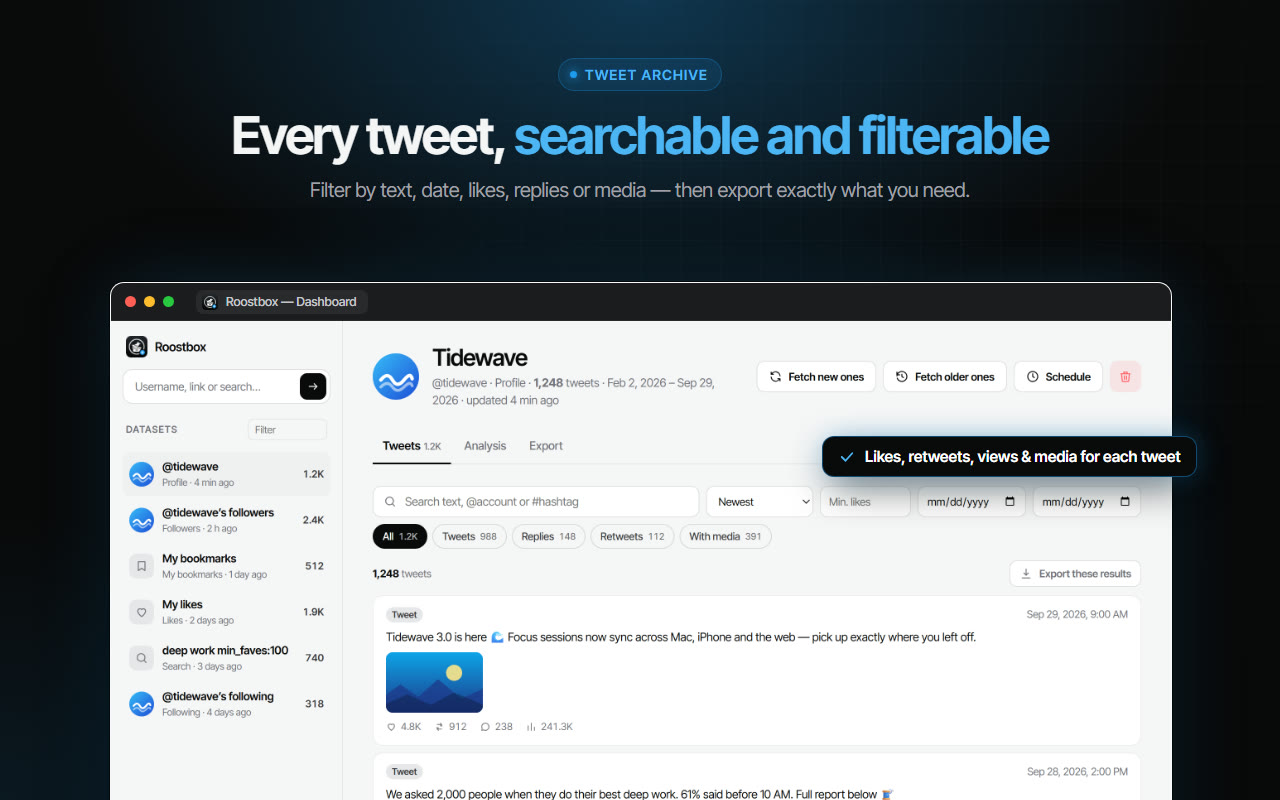
If the page-based route fits what you need, Roostbox works that way. It reads tweets, replies, likes, bookmarks and follower lists from an x.com tab you already have open, and hands them over as Excel, CSV or JSON - including the bookmarks the official archive leaves out. No API key, no password, nothing uploaded anywhere.
It does not claim to recover deleted posts or to reach a private account you do not follow, for the reasons above.
Which route to pick
If you want everything X holds on you, including direct messages and ad data, request the official archive - nothing else gives you that, and it is free. Budget a day for it and be ready to strip a prefix off a file.
If what you actually wanted was to know how to export tweets into a spreadsheet this afternoon - your posts, likes, bookmarks or followers - the archive is the long way round. Read it off the page and keep the file. And whichever route you take, be careful about uploading the raw archive anywhere, because it contains considerably more about you than the part you were actually after.
Frequently Asked Questions
window.YTD.tweets.part0 = before the data starts. Delete that opening fragment, save the file as .json, and normal parsers will read it.